Press & media
Finnish electricity price figures, ready to publish
The figures below update from the same dataset as the site's statistics, and may be published as they stand with attribution. If you need something else, I usually reply the same working day.
Suomeksi: Medialle
Source
What the data covers
Realised day-ahead prices for the Finnish bidding zone from 1 January 2021 to 13 September 2026, 49,967 hours in total. There is not a single missing hour in the series. Hours and months are computed in Finnish local time. Alongside it, an archive of which electricity contracts have actually been offered to consumers and at what price: product-level daily snapshots from 30 July 2026. The Finnish Energy Authority publishes monthly national averages of available products; this archive records prices at product level, every day.
The dataset is archived on Zenodo under a persistent identifier (DOI 10.5281/zenodo.21701225) if your piece needs a citation to a frozen snapshot. Coverage, method, the full list of known limitations and ready-made citation formats are on the English statistics page.
Ready-made
Publication-ready figures right now
Each sentence contains the figure, the caveat it needs to be true, and the attribution. Copy it as it stands.
The average Finnish day-ahead electricity price in August 2026 was 5.18 c/kWh (incl. 25.5 % Finnish VAT; excludes distribution and electricity tax). Source: ParasSähkö.fi, CC BY 4.0.
Over the last 12 months (September 2025 – August 2026) the average Finnish day-ahead price was 6.84 c/kWh, against 5.14 c/kWh in the preceding 12 months — up 33 per cent (incl. 25.5 % Finnish VAT; excludes distribution and electricity tax). Source: ParasSähkö.fi, CC BY 4.0.
In August 2026 the Finnish day-ahead price was negative 0.0 % of the time and below one cent per kilowatt-hour 29.0 % of the time (incl. 25.5 % Finnish VAT; excludes distribution and electricity tax). Source: ParasSähkö.fi, CC BY 4.0.
Across the whole dataset Finnish day-ahead power has been cheapest at 3:00 (4.53 c/kWh) and dearest at 9:00 (12.47 c/kWh) Finnish time, making the dearest clock hour 2.8 times the cheapest (incl. 25.5 % Finnish VAT; excludes distribution and electricity tax). Source: ParasSähkö.fi, CC BY 4.0.
The Nord Pool day-ahead market moved to 15-minute settlement periods on 1 October 2025. This dataset carries quarter-hourly prices from 15 June 2026; measured from those, the gap between the dearest and cheapest quarter within the same hour averages 1.50 c/kWh and exceeds one cent in 43 % of hours. Based on 2,184 hours for which all four quarters are present (incl. 25.5 % Finnish VAT; excludes distribution and electricity tax). Source: ParasSähkö.fi, CC BY 4.0.
On 14 September 2026 the cheapest spot-linked consumer contract orderable online in the ParasSähkö comparison carried a seller margin of 0.32 c/kWh on top of the spot price (incl. 25.5 % Finnish VAT; excludes distribution and electricity tax). Source: ParasSähkö.fi, CC BY 4.0.
Among 12-month fixed-price consumer contracts on offer on 14 September 2026, the cheapest energy price in the ParasSähkö comparison was 11.04 c/kWh and the median 12.29 c/kWh (31 products from 19 suppliers; incl. 25.5 % Finnish VAT; excludes distribution and electricity tax; standing charges and fixed-term promotional rates excluded). Source: ParasSähkö.fi, CC BY 4.0.
Longer time series, the underlying chart data and CSV / JSON downloads are on the statistics page. Need a figure that is not here — a specific day, a longer window, a particular contract type? Ask, and I will send it calculated and sourced.
Reading guide
How a Finnish electricity price figure goes wrong
These are not formalities. They are the points at which a correct figure produces a wrong headline. If any of them is unclear for your story, email me before publishing.
1. The exchange price is not what a household pays
The day-ahead price is the market price of energy. A consumer bill adds the seller’s margin (0.32–1.99 c/kWh in our comparison), a monthly standing charge, distribution and electricity tax. Electricity tax including the security-of-supply fee alone is 2.84 c/kWh, and distribution is priced by the grid operator — it cannot be competed away by switching supplier. A headline saying “electricity cost 5.18 c/kWh” understates a household’s real per-kilowatt-hour cost several times over.
2. Finnish spot figures are usually quoted without VAT — these are not
Nord Pool and most market sources publish Finnish day-ahead prices excluding VAT, in €/MWh. This dataset publishes consumer prices in c/kWh including Finnish VAT. Comparing a figure from here against one from an exchange source without converting is the single most likely error in an international story: the difference is a factor of ten for the unit and a further 25.5 % for the tax.
3. Different years carry different VAT rates
Finnish VAT on electricity has been 24 %, temporarily 10 % (1 December 2022 – 30 April 2023), and 25.5 % from 1 September 2024. Negative prices carry 0 %. VAT-inclusive figures for 2022 and 2026 are therefore not a clean price comparison. The data carries each delivery day’s statutory rate, and the boundaries are documented.
4. A negative price does not mean consumers are paid
A negative day-ahead price applies to the energy component. The seller’s margin, the standing charge, distribution and electricity tax remain payable, and many contracts floor the energy price at zero. The share of negative hours is a genuine market signal — a sign of oversupply — but it is not free electricity.
5. A fixed contract’s energy price is not its total price
The figure in the comparison tables is the energy price. The standing charge (typically a few euros a month) and any fixed-term promotional rate are not in it, so the table cannot tell you which contract is cheapest overall — that depends on consumption. In a small flat the standing charge can decide the comparison; in a large detached house it will not.
6. “Hour” and “quarter” mean different things at different times
The market moved to 15-minute settlement periods on 1 October 2025, but this dataset’s source fed 60-minute prices until 14 June 2026. For that stretch the hourly value is the mean of four quarters: monthly averages remain comparable, but individual quarter-hour peaks and their signs cannot be read from it. If your story is about quarter-hours, use the period from 15 June 2026.
Images
Charts ready for publication
Charts are available as finished files with the title, period and attribution inside the image. They render from the same data as the site’s own charts, so a linked image does not go stale. You are also free to redraw them in your own house style.
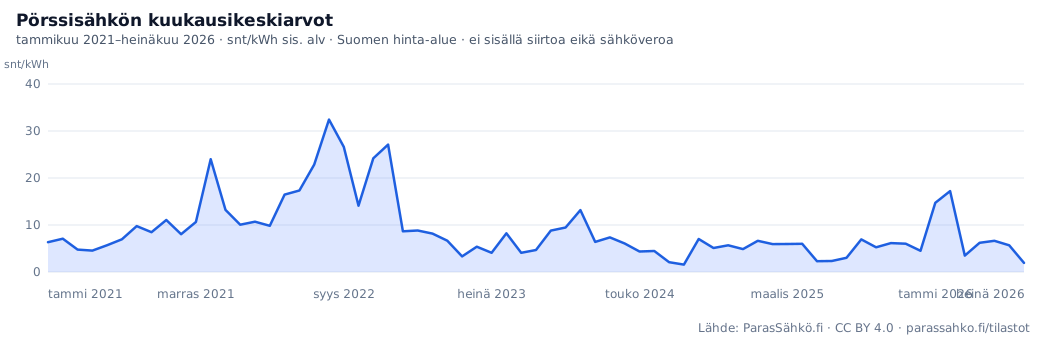
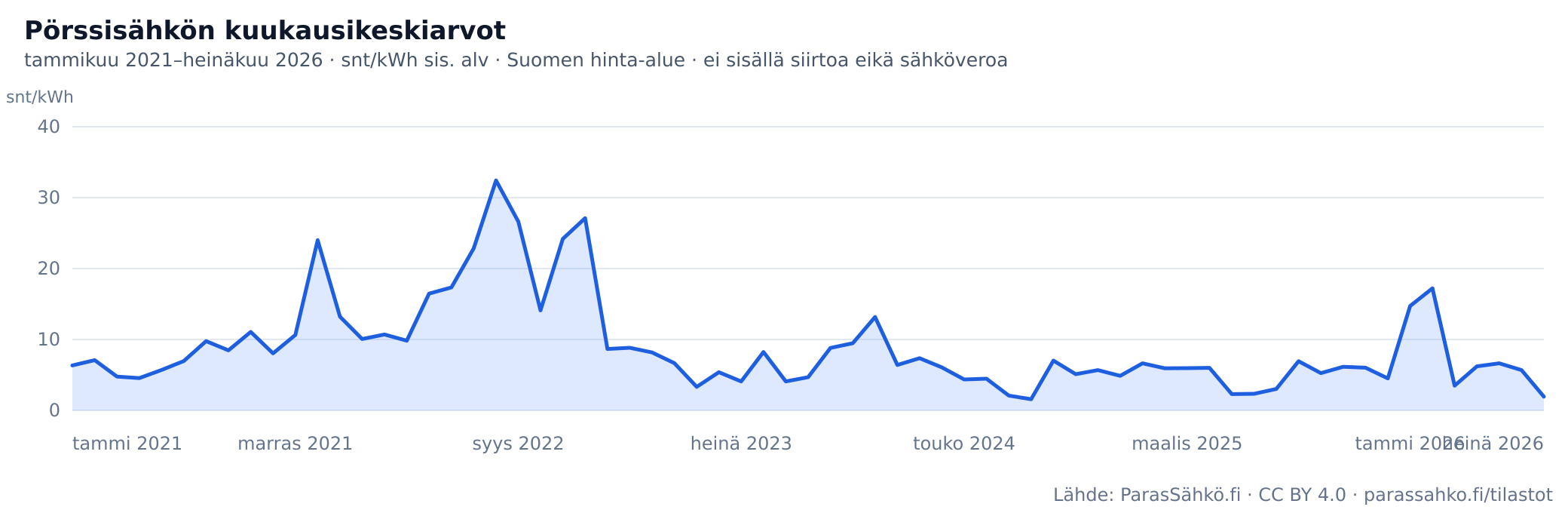
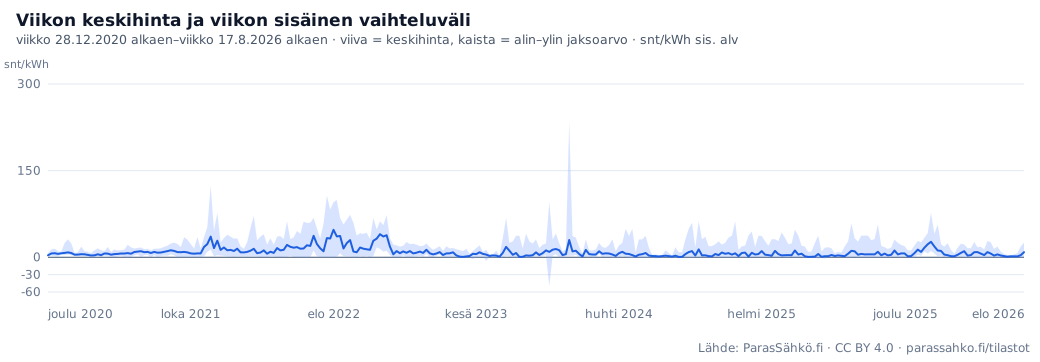
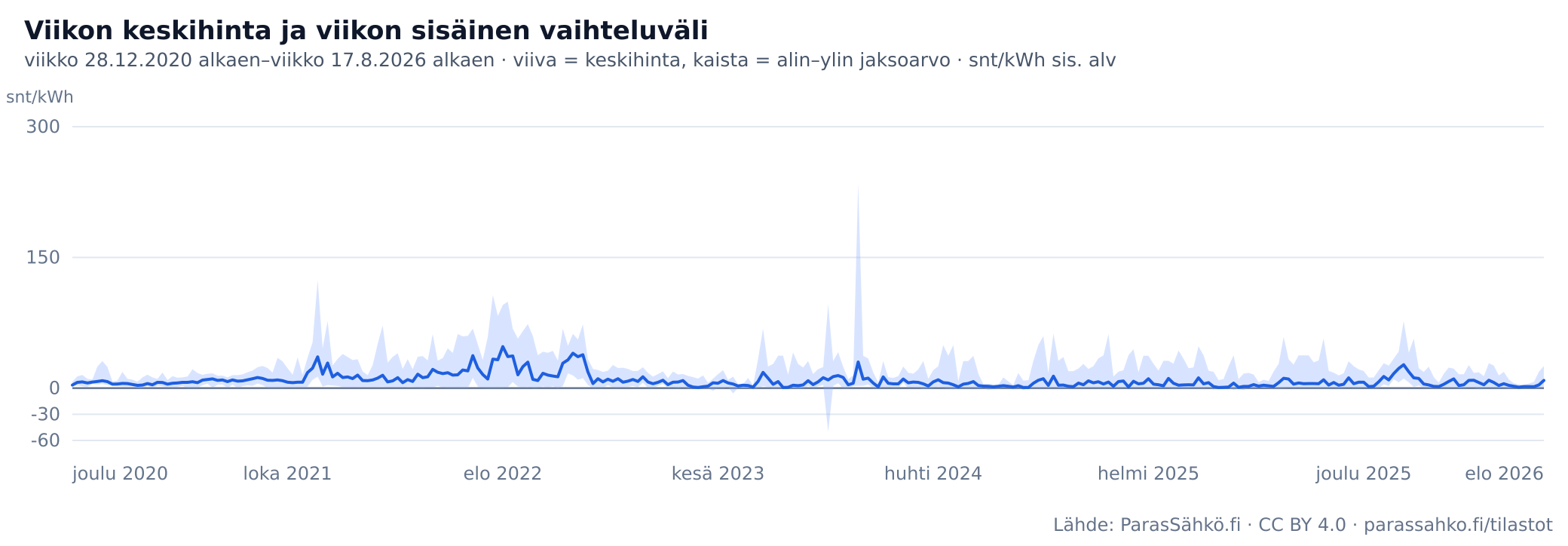
Chart labels are in Finnish. If you need an English-labelled version for print, ask — I will render it. A live self-updating embed is available on the Finnish statistics page.
Licence
You may publish these
The figures, tables and charts may be published, including commercially, provided the source is credited. The licence is Creative Commons Attribution 4.0. It is enough for the piece to say Source: ParasSähkö.fi; a link is not required but is appreciated and lets readers check the figure.
In print, attribution in the caption or beside the graphic is sufficient; online a link to parassahko.fi/en/statistics is preferred; on radio or television a spoken mention is enough. No permission is needed and no notification is required — though you do me a favour by telling me, because I would rather correct an error before it spreads.
If you publish a figure, state its VAT treatment: prices include Finnish VAT, and distribution and electricity tax are not included. Without that caveat the figure misleads the reader.
Limitations
What this data cannot tell you
A source that lists only its strengths has not earned trust. These are the known limits, and I would rather state them in advance than in a correction.
- Prices come through the Porssisahko.net API, not directly from Nord Pool. This is not our own measurement, and the source chain is documented.
- The data covers list prices and exchange quotations, not actual bills. We do not measure consumption and cannot see which contracts were in fact signed.
- The contract comparison covers products generally available to consumers. Business contracts, local offers and negotiated prices are absent.
- Distribution and electricity tax are not included. Distribution is priced by the local grid operator and cannot be changed by switching supplier.
- The contract price archive is young. It does not yet support long-run conclusions about the contract market — the spot price history, by contrast, reaches back to 2021.
- We do not forecast prices. The data says what has happened and what is on offer.
The dataset has also changed retroactively more than once — the price history was extended back to 2021 and a number of source VAT errors were corrected. If you have already published a figure from this data, the dataset changelog says what changed and which figures it affects.
Contact
Who answers
Iiro Pasanen, ParasSähkö.fi / Funky Labs Oy. Email info@parassahko.fi. I usually reply the same working day, in Finnish or English. If you are on a deadline, put it in the subject line and I will prioritise it.
What I can comment on: realised Finnish day-ahead prices and their history since 2021, seasonal and time-of-day variation, how common negative prices are, the move to 15-minute settlement, and which contracts have been offered to consumers at what price — from product-level daily observations, not monthly averages.
What I will not:I do not forecast future electricity prices and I do not comment on individual suppliers’ business. The data says what has happened and what is on offer, not what the price will do next winter.
The service is operated by Funky Labs Oy (business ID 3628630-3). It is independent and does not sell electricity; the funding model is described on the Finnish about page.